
Sunday, 13 August 2017
Sheep painting video part 3

Saturday, 12 August 2017
Sheep painting video part 2
In part 2 of this sheep painting video, I continue to use the Liquitex
acrylic paint marker (burnt umber) to introduce some hills and trees to
the background Devon landscape. Then, I begin to add a sense of light
and dark to the painting by defining the shadow regions on the sheep and
lamb.
Friday, 11 August 2017
Sheep painting video part 1
Tuesday, 8 August 2017
Liquitex Professional Paint Marker Review
I've recently started using Liquitex Professional Paint markers in my work. These marker pens, that are filled with acrylic paint rather than ink, are surprisingly expressive as they provide a wide variety of mark and line. They are also really useful for painting on location. I've used them to create drawings and also begin paintings. In the video below I go through the type of marks you can make, chat about some of my recent work using these pens and then do a quick cow sketch to show them in action.
Monday, 1 May 2017
Exeter Art Society - Artist Demonstration
Had a great time painting a Belted Galloway Cow at Exeter Art Society the other night, thanks to everyone who came along!
 Here's the finished painting
(above) that I did for the demo, this Belted Galloway cow was created
using Atelier Acrylics over the top of dried conventional acrylics, one
of my favourite techniques.
Here's the finished painting
(above) that I did for the demo, this Belted Galloway cow was created
using Atelier Acrylics over the top of dried conventional acrylics, one
of my favourite techniques.
 Everyone at Exeter Art Society made me feel very welcome and there was
lots of insightful (and humourous :-) ) discussion during the demo. The
photos here (above) are: top left: setting up for the evening, as I painted, my progress was projected onto the screen; mid left: people starting to arrive, there were about 37 people in attendance; bottom left: an audience member grabs a pic of the finished painting; right: micro exhibition and laptop slideshow for the half-time break.
Everyone at Exeter Art Society made me feel very welcome and there was
lots of insightful (and humourous :-) ) discussion during the demo. The
photos here (above) are: top left: setting up for the evening, as I painted, my progress was projected onto the screen; mid left: people starting to arrive, there were about 37 people in attendance; bottom left: an audience member grabs a pic of the finished painting; right: micro exhibition and laptop slideshow for the half-time break.
 Recently discovered this mixed media paper (above) and it's great to
paint on especially after sealing the surface with a coat of acrylic.
Recently discovered this mixed media paper (above) and it's great to
paint on especially after sealing the surface with a coat of acrylic.
 To start, I did some very quick and very loose line drawings (above)
where I don't worry at all about the results, it's a good way to warm up
before moving on to the main picture.
To start, I did some very quick and very loose line drawings (above)
where I don't worry at all about the results, it's a good way to warm up
before moving on to the main picture.
 These patches of colour (above) were used to demonstrate the unique
properties of the Atelier Acrylics. The paint on the left is
conventional acrylic, the patch on the right is Atelier interactive.
Initially, they both looked identical and, once dry, I asked each person
in the audience to feel that both patches of paint were dry. Once
everyone was satisfied, I sprayed both with water and demonstrated that
the patch of conventional acrylic was completely waterproof by rubbing a
brush over the top. However, when a brush was used on the Interactive
paint it was reactivated and was easy to move around on the paper (this
makes for much easier blending than conventional acrylics allow).
These patches of colour (above) were used to demonstrate the unique
properties of the Atelier Acrylics. The paint on the left is
conventional acrylic, the patch on the right is Atelier interactive.
Initially, they both looked identical and, once dry, I asked each person
in the audience to feel that both patches of paint were dry. Once
everyone was satisfied, I sprayed both with water and demonstrated that
the patch of conventional acrylic was completely waterproof by rubbing a
brush over the top. However, when a brush was used on the Interactive
paint it was reactivated and was easy to move around on the paper (this
makes for much easier blending than conventional acrylics allow).


Above: A close-up of the cow head,
I used the Atelier Acrylics to define the details and created some
blended effects / soft edges on different parts of the animal.
Really enjoyed the evening, thanks to everyone who helped me pack everything away. Check out Exeter Art Society's website here.
Tuesday, 4 April 2017
Private View: Landscape Artist of the Year 2016 at the Mayne Gallery in Kingsbridge, Devon
As mentioned in recent posts, I was lucky enough to be named a finalist in the Devon Life Magazine Landscape Artist of the Year 2016. The work of the six finalists is now showing in an exhibition at the Mayne Gallery in Kingsbridge and here are some photos from the private view that took place the other night.




Sunday, 26 March 2017
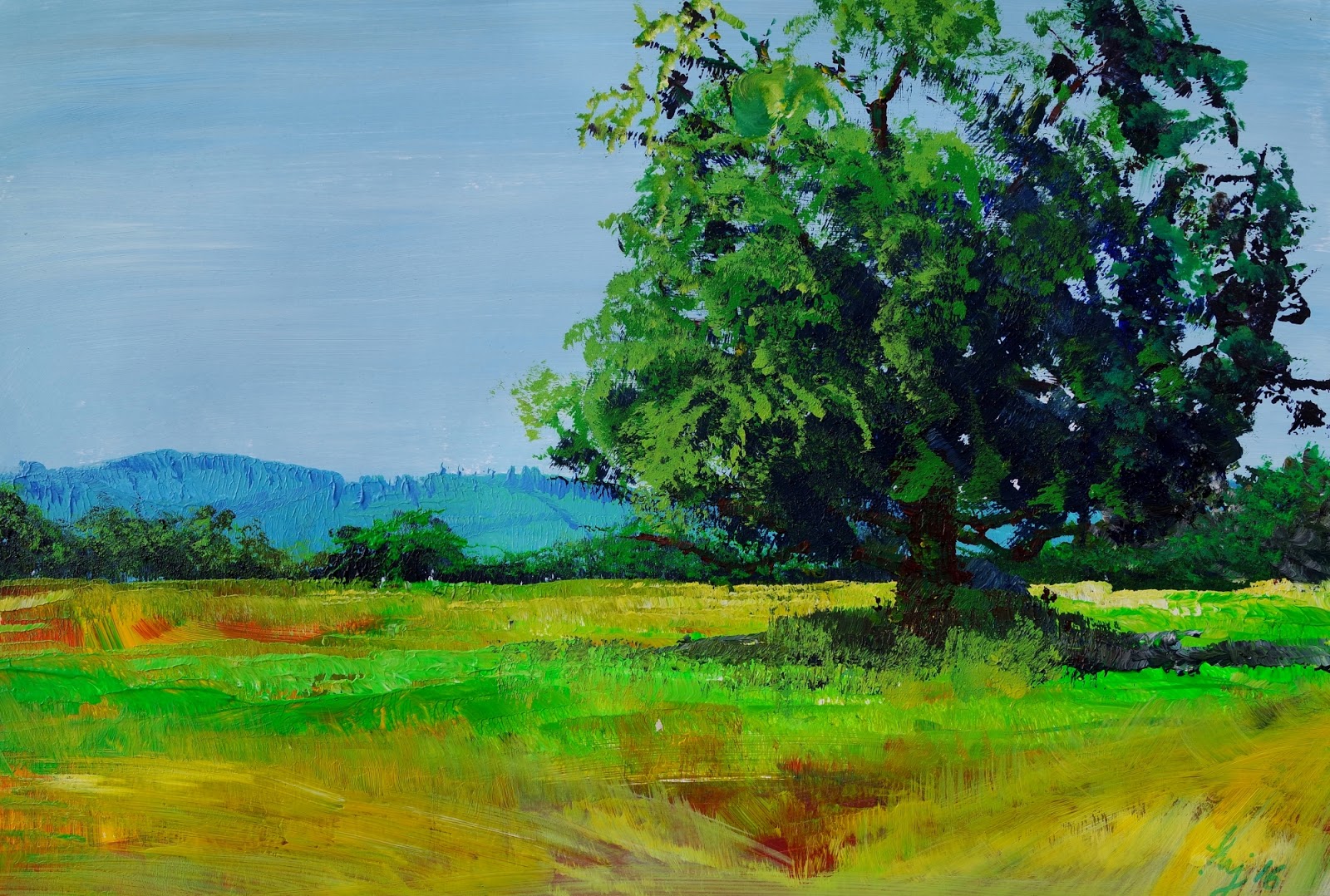
Landscape paintings on show at Mayne Gallery in Kingsbridge in Devon
I have some paintings going on show for the first 3 weeks of April at the Mayne Gallery in Kingsbridge, South Hams, Devon. The exhibition is to celebrate the work of the six finalists in the Devon Life Landscape Painter of the year competition and also features work by James Tatum, Cherry Lyons, Peter Blakesley, Laura Boyd and Johanna Mcweeney


Subscribe to:
Posts (Atom)

